


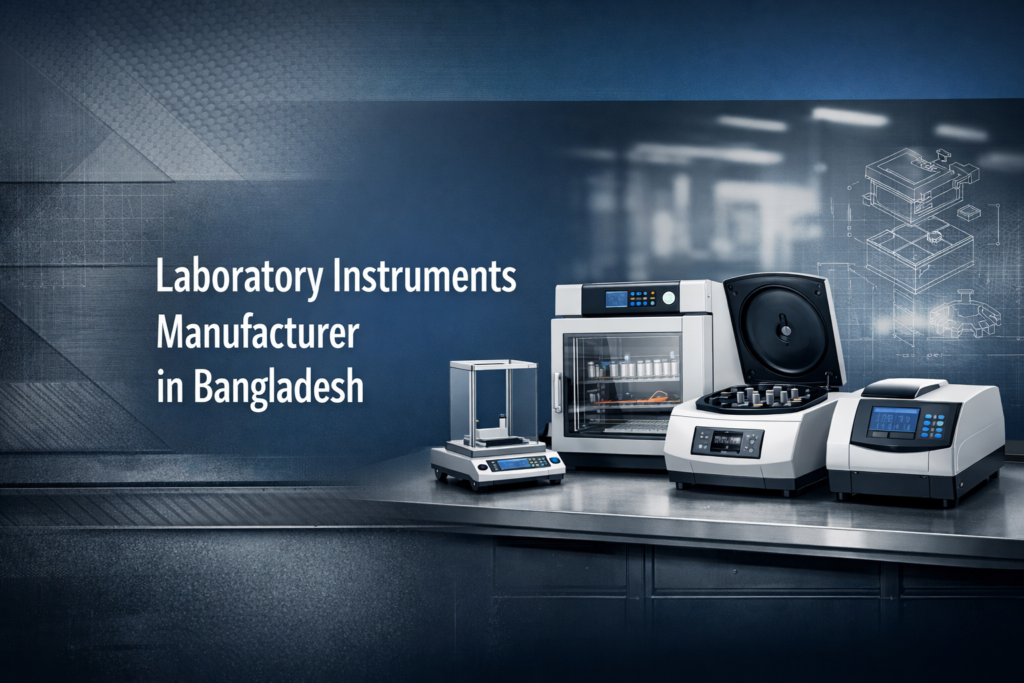
Bangladesh has emerged as a strong hub for laboratory infrastructure development across healthcare, education, pharmaceuticals, agriculture, and industrial testing. A laboratory instruments manufacturer in Bangladesh plays a critical role in supporting this ecosystem by producing dependable, application-focused equipment designed for real laboratory conditions. Local manufacturing ensures better accessibility, reduced procurement timelines, and instruments adapted to regional operational requirements.
Manufacturers in Bangladesh focus on functional design, consistency, and scalability. Instead of generic imports, laboratories benefit from instruments engineered to meet daily workflow demands, regulatory expectations, and long-term operational stability.
Growing Importance of Laboratory Instrument Manufacturing
Laboratory instruments form the backbone of diagnostics, research, quality assurance, and scientific education. Manufacturing these instruments locally strengthens national capability and supports self-reliance in critical sectors.
The presence of a laboratory instruments manufacturer in Bangladesh contributes to:
- Reduced dependence on imported laboratory equipment
- Faster delivery and replacement cycles
- Cost efficiency for institutions and laboratories
- Customization based on user requirements
- Skill development and technical employment
These factors collectively enhance laboratory performance across public and private sectors.
Core Laboratory Instruments Manufactured
General Laboratory Equipment
Manufacturers in Bangladesh produce essential laboratory instruments used in routine scientific and industrial operations. These instruments are designed for durability and continuous use.
- Laboratory centrifuges
- Hot air ovens
- Laboratory incubators
- Water baths
- Orbital and linear shakers
Each instrument undergoes functional testing to ensure reliable performance in day-to-day laboratory environments.
Laboratory Glassware and Plasticware
Glassware and plasticware manufacturing supports chemistry, biology, and teaching laboratories. Products are manufactured using lab-grade materials and standardized measurements.
- Beakers and flasks
- Measuring cylinders
- Pipettes and burettes
- Reagent bottles
- Sample storage containers
These products are suitable for academic labs, research facilities, and industrial testing units.
Analytical and Measurement Instruments
Analytical instruments manufactured or assembled locally support precision testing and monitoring activities.
- pH meters
- Conductivity meters
- Laboratory balances
- Total dissolved solids meters
- Moisture analyzers
Such instruments are widely used in food testing, water analysis, pharmaceuticals, and environmental monitoring.
Clinical and Diagnostic Laboratory Instruments
Healthcare laboratories depend on consistent access to diagnostic instruments. Manufacturers in Bangladesh supply equipment designed for routine clinical applications.
- Clinical centrifuges
- Laboratory mixers
- Sample preparation equipment
- Sterilization units
Design priorities include safety, ease of operation, and maintenance simplicity.
Manufacturing Standards and Quality Assurance
Laboratory instruments manufacturers in Bangladesh implement structured quality control systems to maintain product reliability. Each stage of production is monitored to ensure compliance with defined specifications.
Quality assurance processes typically include:
- Inspection of raw materials and components
- Dimensional and assembly verification
- Functional and performance testing
- Electrical safety checks where applicable
- Final inspection prior to dispatch
These measures help ensure consistency across production batches and long-term usability.
Customization and Application-Specific Solutions
Different laboratories operate under varying space, power, and workflow constraints. A laboratory instruments manufacturer in Bangladesh offers customization to meet specific institutional needs.
Customization options include:
- Instrument size and capacity adjustments
- Voltage and power compatibility modifications
- Workflow-oriented design changes
- Institution branding for educational setups
This flexibility allows laboratories to integrate instruments seamlessly into existing environments.
Support for Educational Institutions
Schools, colleges, and universities represent a major segment of laboratory instrument users. Manufacturers align product design with academic curricula and teaching requirements.
Educational support includes:
- Curriculum-aligned laboratory equipment
- Demonstration-friendly instrument design
- User manuals and safety documentation
- Availability of spare parts for long-term use
This approach enhances practical learning and laboratory skill development.
Industry Applications
Healthcare and Medical Diagnostics
Hospitals and diagnostic centers rely on laboratory instruments for routine testing and analysis. Local manufacturing supports timely availability and responsive technical support.
Pharmaceutical and Chemical Industries
Pharmaceutical manufacturing units use laboratory instruments for quality control, formulation testing, and compliance verification.
Agriculture and Food Testing
Laboratory instruments support soil testing, fertilizer analysis, crop quality evaluation, and food safety assessment.
Environmental and Water Analysis
Environmental laboratories use analytical instruments to monitor water quality, pollution levels, and ecological indicators.
Packaging and Distribution Capability
Manufacturers in Bangladesh prepare laboratory instruments for safe transportation across domestic and international supply chains.
Packaging practices include:
- Protective cushioning for sensitive components
- Clear labeling and handling instructions
- Batch identification for traceability
- Export-ready packing for overseas shipments
Advantages of Choosing a Manufacturer in Bangladesh
- Direct communication with production teams
- Reduced lead times
- Adaptation to regional laboratory conditions
- Competitive manufacturing costs
- Support for local industrial growth
These advantages make locally manufactured laboratory instruments a practical choice for diverse laboratory applications.
Future Outlook
The laboratory instruments manufacturing sector in Bangladesh continues to evolve. Manufacturers are focusing on improved design precision, expanded analytical capabilities, and stronger quality systems.
With ongoing investment in healthcare, education, pharmaceuticals, and research infrastructure, demand for locally manufactured laboratory instruments is expected to grow steadily.
Conclusion
A laboratory instruments manufacturer in Bangladesh plays a vital role in strengthening scientific capability across sectors. Through localized production, quality-driven manufacturing, and application-focused design, manufacturers support laboratories with dependable instruments tailored to real-world requirements.