


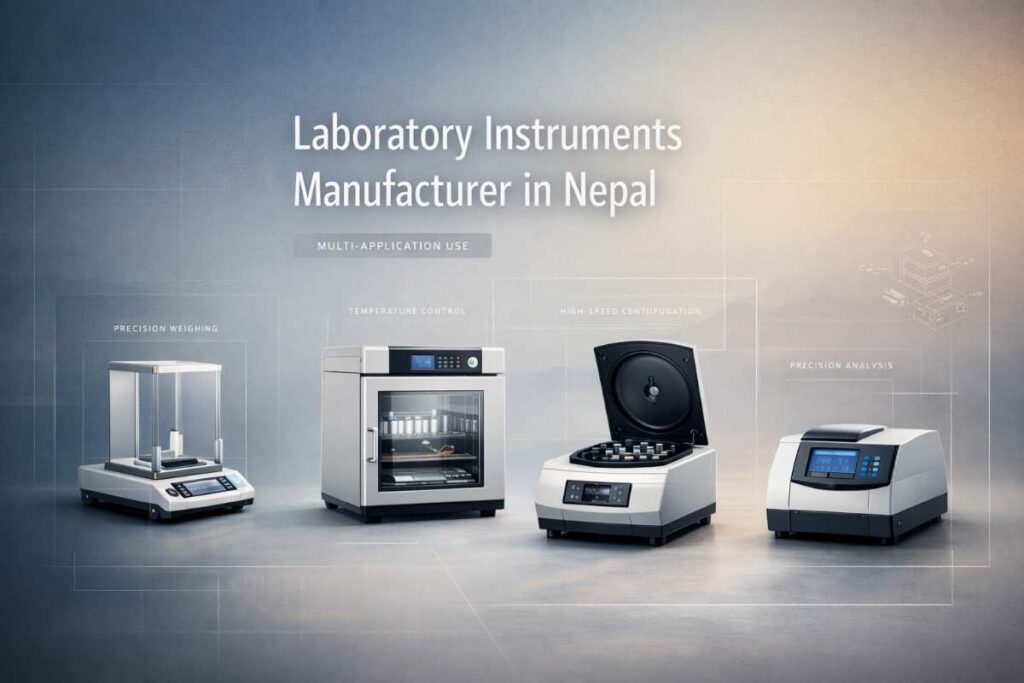
The demand for reliable laboratory infrastructure in Nepal has grown steadily with expansion in healthcare services, academic research, pharmaceuticals, agriculture, and industrial quality control. A laboratory instruments manufacturer in Nepal plays a crucial role in supporting this growth by producing equipment that meets local laboratory conditions while maintaining performance consistency and operational safety. Local manufacturing enables laboratories to access dependable instruments without long import lead times or compatibility issues.
Laboratory instruments are the foundation of scientific work. From routine testing to advanced research, the quality and reliability of instruments directly affect results, accuracy, and long-term efficiency. Manufacturers operating in Nepal focus on practical design, durability, and application-specific functionality rather than generic one-size-fits-all products.
Importance of Local Laboratory Instrument Manufacturing
Manufacturing laboratory instruments within Nepal supports national scientific capability and reduces dependency on imported equipment. Local production also strengthens technical skills, supply chain stability, and after-sales support.
- Shorter procurement and delivery timelines
- Better adaptation to local power and climate conditions
- Cost-effective solutions for institutions
- Improved access to servicing and spare parts
- Support for domestic technical expertise
These advantages help laboratories maintain consistent workflows and operational continuity.
Categories of Laboratory Instruments Manufactured
General Laboratory Equipment
General laboratory equipment forms the backbone of daily laboratory operations. Manufacturers in Nepal produce instruments designed for continuous use in academic, clinical, and industrial laboratories.
- Laboratory centrifuges
- Hot air ovens
- Laboratory incubators
- Water baths
- Magnetic and mechanical stirrers
These instruments are engineered to provide stable performance under routine laboratory conditions.
Analytical and Measuring Instruments
Analytical instruments are essential for precision testing and monitoring. Nepal-based manufacturers focus on accuracy, repeatability, and ease of calibration.
- Laboratory balances
- pH meters
- Conductivity meters
- TDS meters
- Moisture analyzers
Such instruments are widely used in water testing, food analysis, pharmaceuticals, and environmental monitoring.
Laboratory Glassware and Consumables
Glassware and consumables are fundamental to chemical and biological laboratories. Manufacturers supply standardized laboratory glassware suitable for teaching and research applications.
- Beakers and flasks
- Measuring cylinders
- Pipettes and burettes
- Test tubes and reagent bottles
Products are manufactured with attention to measurement accuracy and material durability.
Clinical and Diagnostic Laboratory Equipment
Healthcare laboratories require dependable instruments for routine diagnostic procedures. Local manufacturing ensures faster availability and easier maintenance.
- Clinical centrifuges
- Sample mixers
- Sterilization equipment
- Laboratory heating units
Design priorities include safety, user-friendly operation, and consistent output.
Manufacturing Process and Quality Control
Laboratory instruments manufacturers in Nepal follow structured production processes to maintain quality and performance standards. Each manufacturing stage is monitored to reduce variability and defects.
Quality control practices typically include:
- Raw material inspection
- Component-level testing
- Assembly verification
- Functional and load testing
- Final inspection before dispatch
These checks ensure that instruments perform reliably throughout their service life.
Customization and Application-Based Design
Different laboratories operate under varying constraints related to space, power supply, and workflow. A laboratory instruments manufacturer in Nepal offers customization to meet these specific needs.
- Customized capacity and dimensions
- Voltage and power configuration options
- Workflow-oriented layout adjustments
- Educational labeling and branding
Customization improves integration with existing laboratory infrastructure.
Support for Educational Institutions
Educational laboratories require instruments aligned with curriculum objectives. Manufacturers design equipment that supports demonstration, experimentation, and student safety.
Support for education includes:
- Curriculum-aligned laboratory kits
- Demonstration-friendly equipment
- Clear user manuals and safety guidelines
- Long-term availability of spare parts
This enables institutions to maintain functional laboratories over extended periods.
Industry-Specific Applications
Healthcare and Diagnostics
Hospitals and diagnostic centers depend on laboratory instruments for testing and sample processing. Local manufacturing ensures timely access and technical support.
Pharmaceutical and Chemical Processing
Pharmaceutical laboratories use instruments for formulation testing, quality assurance, and compliance monitoring.
Agriculture and Food Testing
Agricultural laboratories rely on instruments for soil analysis, crop testing, fertilizer evaluation, and food quality control.
Environmental and Water Analysis
Environmental testing laboratories use analytical instruments to monitor water quality, pollution levels, and ecological indicators.
Packaging and Distribution
Laboratory instruments manufactured in Nepal are prepared for safe transportation to laboratories across the country and for export where required.
- Protective cushioning for sensitive components
- Clear handling and installation instructions
- Batch identification and traceability
- Export-ready packaging options
Advantages of Choosing a Manufacturer in Nepal
- Direct coordination with production teams
- Reduced dependence on imports
- Adaptation to local laboratory conditions
- Cost-efficient manufacturing
- Contribution to national scientific growth
These benefits make locally manufactured laboratory instruments a practical and sustainable choice.
Future Outlook
The laboratory instruments manufacturing sector in Nepal is steadily evolving. Manufacturers are investing in improved design precision, expanded analytical capabilities, and stronger quality systems. As laboratory infrastructure continues to develop, locally manufactured instruments will play an increasingly important role.
Conclusion
A laboratory instruments manufacturer in Nepal supports scientific progress across healthcare, education, agriculture, and industry. Through reliable manufacturing practices, application-driven design, and localized support, manufacturers contribute to stronger laboratory performance and long-term scientific capability.