


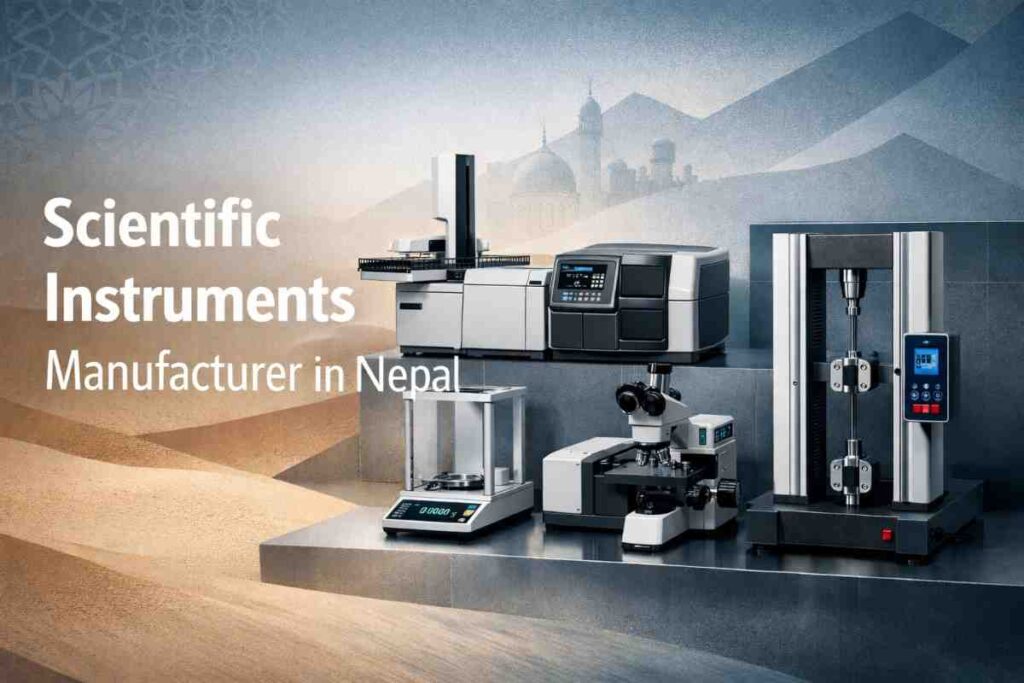
Nepal has steadily built capacity in scientific manufacturing to support education, healthcare, research, agriculture, and industrial testing. A scientific instruments manufacturer in Nepal focuses on producing functional, standardized, and application-specific equipment suited for regional conditions. Local manufacturing reduces dependency on imports, shortens supply cycles, and supports customization for institutions operating in diverse terrains and climates.
You benefit from equipment designed for real laboratory workflows. Production aligns with academic curricula, regulatory lab needs, and field research requirements common across Nepal and neighboring regions.
Role of Scientific Manufacturing in Nepal
Scientific instrument manufacturing plays a direct role in national development. Laboratories form the backbone of research, diagnostics, quality control, and technical training. Local manufacturers support this ecosystem through consistent production and supply.
Manufacturing units in Nepal focus on:
- Supplying educational laboratories at school and university level
- Supporting hospital diagnostics and pathology labs
- Providing testing tools for agriculture and food analysis
- Serving industrial quality control units
- Enabling research centers and government labs
This approach strengthens self-reliance while meeting international laboratory practices.
Product Categories Manufactured
Laboratory Glassware
Glassware production remains a core manufacturing segment. Items are produced using standardized volume markings and lab-grade materials.
- Beakers and flasks
- Burettes and pipettes
- Measuring cylinders
- Condensers and adapters
These products support chemistry labs, teaching institutes, and routine analysis units.
Educational Laboratory Equipment
Manufacturers in Nepal supply instruments aligned with science curricula. Equipment supports hands-on learning across physics, chemistry, and biology labs.
- Physics experiment apparatus
- Chemistry lab kits
- Biology teaching models
- Basic microscopes and slides
Design focuses on safety, clarity of demonstration, and repeated classroom use.
Analytical and Testing Instruments
Local manufacturers assemble and integrate analytical tools for routine testing.
- pH meters and conductivity meters
- Laboratory balances
- Water testing instruments
- Soil and fertilizer testing tools
These instruments support agriculture labs, water authorities, and industrial monitoring.
Clinical and Diagnostic Equipment
Healthcare labs depend on consistent instrument supply. Manufacturing supports basic diagnostic workflows.
- Centrifuges
- Incubators
- Laboratory shakers
- Sterilization units
Equipment design emphasizes operational stability and ease of maintenance.
Manufacturing Standards and Quality Control
Scientific instruments manufactured in Nepal follow defined production protocols. Manufacturers apply inspection at each stage of fabrication and assembly.
Quality practices include:
- Raw material verification
- Dimensional checks
- Functional performance testing
- Calibration validation where applicable
- Packaging inspection before dispatch
These steps support consistent output and suitability for laboratory use.
Customization for Local and Regional Needs
A key advantage of working with a scientific instruments manufacturer in Nepal lies in customization. Institutions often require instruments adapted to space limitations, power conditions, or specific experiment protocols.
Customization options include:
- Modified dimensions
- Voltage and power adjustments
- Application-specific configurations
- Institution branding for academic labs
This flexibility supports schools, colleges, and regional labs with distinct operational needs.
Support for Education and Skill Development
Manufacturers collaborate with academic institutions to align products with teaching objectives. This ensures students gain practical exposure using instruments relevant to real laboratory environments.
Educational support includes:
- Curriculum-aligned lab kits
- Instructor guides and manuals
- Replacement parts availability
- Scalable setups for batch training
This integration strengthens science education and workforce readiness.
Applications Across Industries
Agriculture and Food Testing
Nepal’s agricultural sector depends on soil, water, and crop testing. Scientific instruments support quality assessment and productivity analysis.
- Soil nutrient testing tools
- Moisture and pH analysis instruments
- Food quality testing equipment
Healthcare and Diagnostics
Hospitals and clinics rely on lab instruments for routine diagnostics. Manufacturers supply essential tools supporting pathology and microbiology labs.
Environmental Monitoring
Environmental agencies use scientific instruments to monitor water quality, air parameters, and ecological indicators.
Industrial Quality Control
Manufacturing and processing units apply laboratory testing to maintain product standards and compliance.
Packaging and Logistics Readiness
Scientific instruments manufacturers in Nepal prepare products for both domestic distribution and export. Packaging protects instruments during transport across varied terrain.
Logistics preparation includes:
- Shock-resistant packaging
- Clear labeling and documentation
- Batch identification for tracking
- Export-friendly packing standards
This approach supports smooth handling across supply chains.
Benefits of Choosing a Manufacturer in Nepal
- Shorter lead times
- Direct communication with production teams
- Adaptation to regional laboratory conditions
- Cost efficiency in procurement
- Support for domestic innovation
You gain access to instruments built with an understanding of operational realities.
Future Outlook
Scientific instrument manufacturing in Nepal continues to evolve. Focus areas include improved automation, broader analytical capability, and expanded export readiness.
Manufacturers invest in skill development and process refinement to meet growing laboratory demand across South Asia and beyond.
Conclusion
A scientific instruments manufacturer in Nepal supports laboratories through practical design, localized production, and responsive supply. This manufacturing ecosystem strengthens education, healthcare, research, and industry while contributing to national technical capacity.