


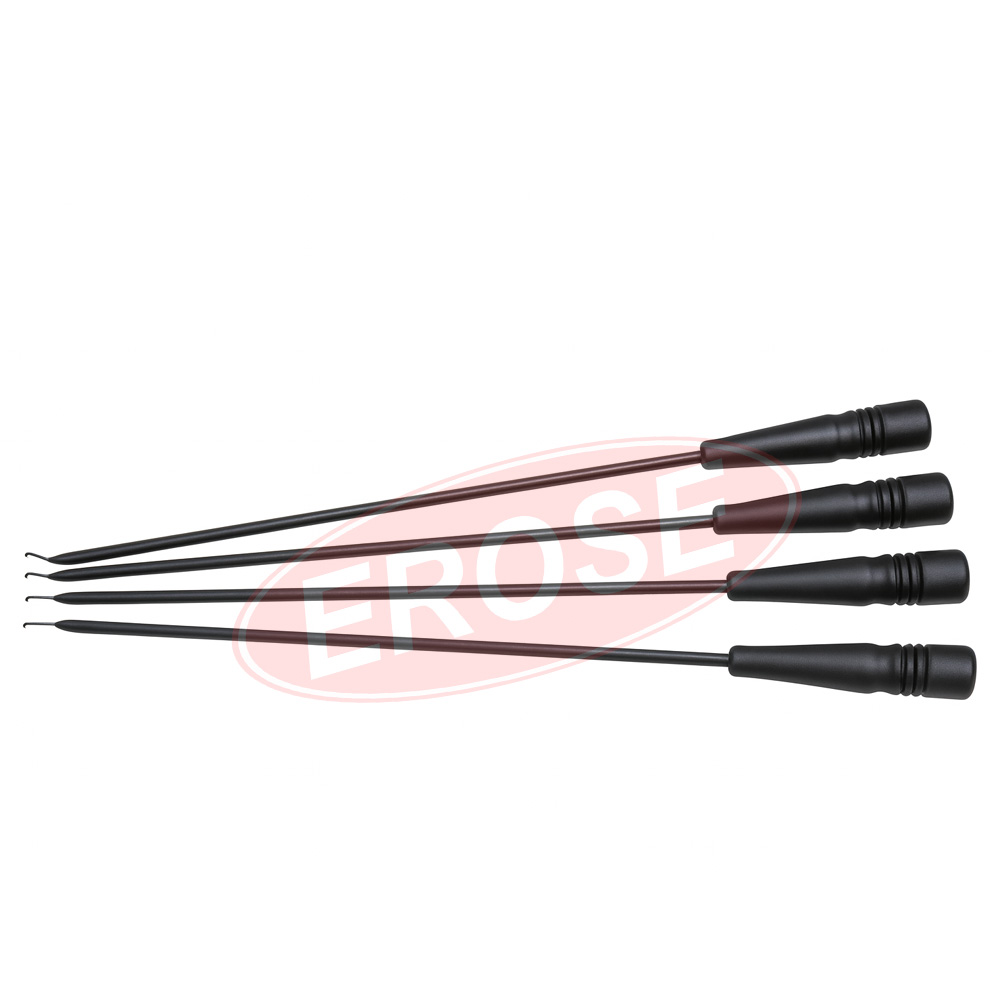

EROSE Laparoscopic Monopolar Spatula L Hook
Glass Agencies presents the EROSE laparoscopic surgery L Hook, an electrosurgical instrument for controlled tissue dissection and cutting during minimally invasive procedures. The instrument combines an L-shaped hook with a spatula-style tip to support different tissue-handling techniques. In addition, the insulated shaft helps direct monopolar energy toward the active tip during suitable laparoscopic procedures.
Laparoscopic Monopolar Spatula L Hook Features
The L-shaped hook helps surgeons engage and manipulate selected tissue during dissection. At the same time, the spatula tip provides a broader contact surface for controlled tissue separation. As a result, the combined tip design can support different surgical movements within confined laparoscopic spaces.
The tip allows controlled tissue handling while the surgeon maintains visibility of the operative field. Furthermore, its practical shape supports procedures that require careful separation of anatomical planes.
Insulated Shaft and Monopolar Energy
The extended shaft passes through compatible laparoscopic trocars and provides access to deeper surgical areas. Moreover, the insulated shaft covers the non-active portion of the instrument and leaves the working tip exposed.
Therefore, the insulation helps focus monopolar energy at the active tip during appropriate electrosurgical procedures. Surgeons should always use compatible equipment and follow the applicable surgical and electrosurgical protocols.
Ergonomic Handle
The handle provides a comfortable grip and supports controlled instrument movement. In addition, its ergonomic shape helps the surgeon manipulate the tip during dissection and tissue handling.
The handle connects with compatible monopolar electrosurgical equipment. As a result, the instrument can integrate into suitable operating-room setups when the required generator and accessories match the instrument specifications.
Surgical Applications
The instrument can support various laparoscopic procedures that require controlled tissue dissection or cutting. For example, suitable applications may include:
- General laparoscopic surgery
- Gynecological procedures
- Tissue dissection
- Adhesiolysis
- Separation of anatomical planes
- Controlled tissue cutting
- Selected vessel coagulation procedures
Furthermore, the combination of the hook and spatula tip provides surgeons with different options for tissue manipulation during minimally invasive procedures.
Tip Design and Tissue Handling
The hook profile allows the surgeon to engage selected tissue and move it according to the requirements of the procedure. Meanwhile, the spatula surface supports smooth contact during tissue separation.
Consequently, the combined tip configuration can assist with controlled movement in narrow surgical spaces. The surgeon can select the appropriate part of the tip according to the intended tissue-handling technique.
Quality Check by Glass Agencies
Glass Agencies checks each EROSE instrument before supply. During inspection, the team examines the insulation, tip formation, shaft condition, handle connection, and overall construction.
Moreover, the inspection helps confirm stable mechanical connections and suitable physical condition before the instrument reaches the customer.
Cleaning and Handling
After use, the surgical team should clean and process the instrument according to the applicable institutional protocol. In addition, users should inspect the tip, insulation, shaft, and handle before subsequent use.
Proper cleaning, handling, and sterilization procedures help prepare the instrument for future compatible procedures. Users should always follow the applicable instructions for the specific electrosurgical instrument and equipment.
EROSE Electrosurgical Instrument
The EROSE Laparoscopic Monopolar Spatula L Hook combines an L-shaped hook, spatula tip, insulated shaft, and ergonomic handle for suitable minimally invasive electrosurgical applications. Overall, its combined tip design supports controlled tissue manipulation, dissection, and cutting during laparoscopic procedures.
For general information about laparoscopic procedures, users can visit Wikipedia.

Reviews
There are no reviews yet.