


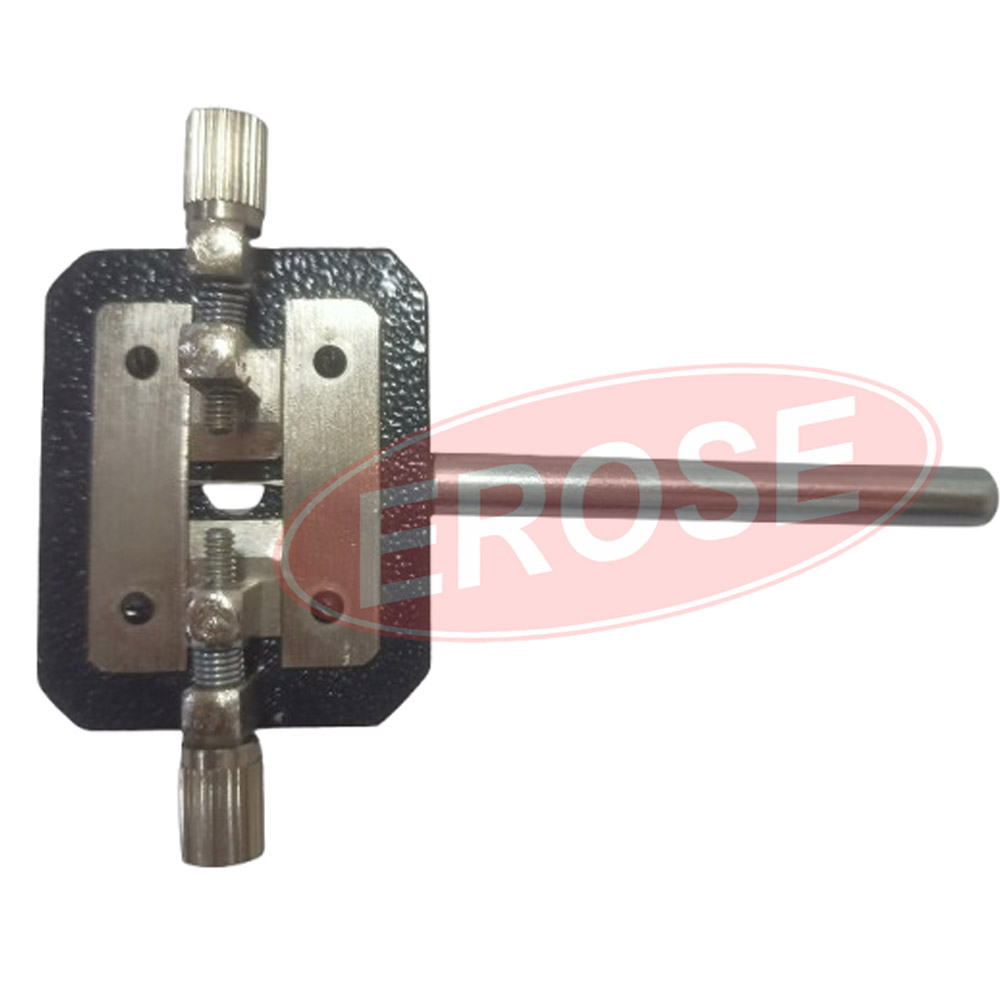

EROSE Metal Young’s Double Slit Apparatus
Glass Agencies manufactures the EROSE Metal Young’s Double Slit Apparatus for demonstrating light interference in schools, colleges, universities, and physics laboratories. Students can use this laboratory instrument to study wave optics, interference patterns, wavelength, and fringe formation through practical experiments.
Young’s Double Slit Apparatus for Physics Laboratory
The apparatus uses a sturdy metal frame with accurately positioned double slits to produce visible interference patterns. Students can measure wavelength and fringe width while demonstrating the wave nature of light. The setup makes Young’s double-slit experiment easier to understand through direct observation and practical measurements.
The compact structure fits conveniently on laboratory tables. Moreover, its simple arrangement helps students perform optical experiments with suitable light sources and screens.
Optical Experiment Applications
Students can use this double slit apparatus to observe bright and dark interference fringes. The experiment demonstrates important concepts such as coherence, interference, wavelength, and fringe formation.
For more information about Young’s Double-Slit Experiment, students can refer to a relevant educational reference. Glass Agencies also supplies scientific and laboratory instruments for physics and educational laboratories.
The instrument supports regular practical classes, classroom demonstrations, and physics laboratory experiments. During practical sessions, students can observe alternate bright and dark fringes and use their measurements for further calculations.
EROSE Physics Laboratory Instrument
Teachers can arrange the Metal Young’s Double Slit Apparatus with a suitable light source and viewing screen according to the experiment. Its straightforward setup makes it useful for physics practical sessions at different educational levels. Students can also observe how light waves interact after passing through two closely spaced openings.
Proper handling and storage can help maintain the apparatus for repeated laboratory use. It provides a practical way to connect theoretical concepts with real laboratory observations and supports learning in optics, wave phenomena, and light interference.
Reviews
There are no reviews yet.