


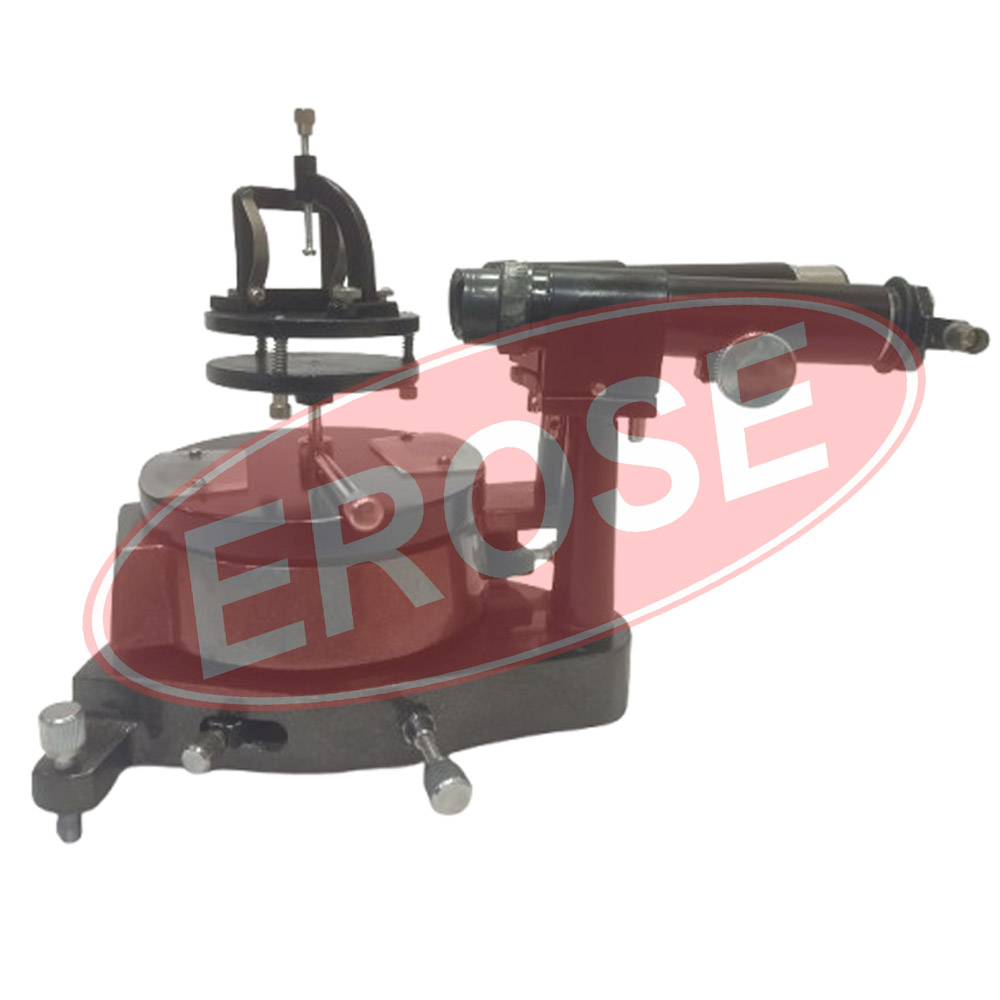

The EROSE Spectrometer, manufactured by Glass Agencies, is an optical laboratory instrument used for measuring angles and studying the properties of light. It is suitable for schools, colleges, universities, research institutes, and physics laboratories for experiments involving wavelength, refraction, dispersion, prism analysis, and diffraction.
Spectrometer for Physics Laboratory
The instrument consists of a telescope, collimator, graduated circular scale, and adjustable prism table. The collimator produces a parallel beam of light, while the telescope helps observe the resulting spectrum or image. The graduated scale allows angular measurements to be taken during practical experiments.
The adjustable prism table provides convenient positioning of prisms and other optical elements during experiments. Students can observe changes in the direction of light and record angular readings for further calculations. The optical arrangement helps demonstrate important principles of geometrical and physical optics through practical laboratory work.
Laboratory Applications
The EROSE instrument can be used for studying light dispersion, measuring the refractive index of prism materials, determining diffraction angles, observing optical spectra, and performing wavelength-related experiments. Its adjustable components allow convenient positioning of optical elements during laboratory work.
The sturdy construction and smooth mechanical movement make it suitable for repeated educational experiments. Students can use the setup to compare theoretical concepts with practical observations and develop a better understanding of refraction, diffraction, interference, and dispersion.
EROSE Optical Laboratory Instrument
Glass Agencies manufactures and supplies the EROSE range of scientific, laboratory, medical, and ophthalmic instruments. This optical instrument is suitable for classroom demonstrations, physics practical sessions, educational presentations, and laboratory research.
For additional information about spectroscopy and optical measurements, students and researchers can refer to established educational resources. The instrument can be stored conveniently after laboratory use and maintained through standard laboratory handling procedures.
Its practical arrangement, readable angular scale, and adjustable optical components make it a useful addition to educational laboratories where light and optical phenomena are studied through direct experimentation. It also provides students with an opportunity to perform measurements systematically and understand how optical instruments are used in practical physics experiments.
Reviews
There are no reviews yet.